your basket is empty
 View Basket
 Recover Basket

Hibiscus (Tropical Hibiscus), Pavonia & Sabdariffa
|
Hibiscus (including the recently in 2025 reinstated genus Sabdariffa) and Pavonia are mostly perennial evergreen to rarely deciduous shrubs, few tropical species are growing as annuals. All require a well drained substrate in full sun and plenty of water in summer. Tropical species should be kept drier in a sunny spot in winter at some 15°C to 20°C. Sow flat at a minimum of some 20°C in any rocky or sandy soil, keep pots always in full sun. 10 seeds per package, if not stated differently. Note on seed availability: All species in section Lilibiscus (e. g. Hibiscus arnottianus, Hibiscus boryanus, Hibiscus fragilis, Hibiscus kokio, etc.) as well as some other woody members (e g. Hibiscus insularis and Hibiscus scottii) are much sought after by collectors and are mostly very rare in cultivation. Seed set in most of these species is very irregular and unpredictable. Despite a continued flowering period from spring through early winter, our cultivated plants usually fruit around early summer (May and June) and then again in early autumn (September and October) only. Whereas in full summer heat all developing seed capsules are usually aborted. Thus you have the best chance to get a hold on one of these rare species by occasionally checking our webshop for new arrivals in early summer and early autumn. You find more hibiscus in these categories: Hibiscus (Hardy Mallow), Muenchhusia (Swamp Mallow) & Kosteletzkya (Saltmarsh Mallow), and Tropical Hibiscus Hybrids. A note on Hibiscus seeds being offered on several selling platforms: On severall well-known U.S. American, European and Chinese selling platforms you will find thousands and thousands hibiscus seeds on offer. And before you throw away your money, keep in mind the following. There does not exist any true blue, nor any vivid emerald green or any rainbow colored hibiscus. These are all photoshopped images and without any exception these offers are scams. Also, Hibiscus rosa-sinensis cultivars will never come 100% true from seeds. If you are lucky enough, you will receive at least some hibiscus seeds (and not some other plant species you didnt' want). However, the color in your plants will never be the one shown on the photo. In the best case your plants will be close, but they will never be identical - genetically this is simply impossible. Then never ever buy anything from any seller who may also offer: blue tomatoes, blue or violet strawberries, blue, pure black or rainbow colored roses, blue or rainbow colored chrysanthemums, rainbow colored grapes, true blue orchids, blue cucumbers, blue sunflowers, blue pumpkins, etc. All these are fakes and you will be scammed. Last but not least, it should ring your alarm bells, if a particular seller uses "borrowed" photos from the web without giving any credit to the image copyright owner. In most cases a simple reversed Google image search will reveal the real source for a particular photo. Serious sellers will always use photos taken from their own plants, or at least they will give credit, if they use a photo from a different source. U.S. customers only: Hibiscus seeds cannot be shipped to the U.S. |
Articles

|
Hibiscus arnottianus (Arnott's Hibiscus)200 (500)cm, Arnott's Hibiscus (Kokiʻo Kea or Koki'o Keokeo in Hawaiian language) is an evergreen tall shrub native of the Koʻolau mountains on Oʻahu island, Hawaii, USA. Hibiscus arnottianus is among the also Hawaiian endemic Hibiscus hannerae, Hibiscus immaculatus, Hibiscus punaluuensis and Hibiscus waimeae the only slightly violet or rose fragrant Hibiscus species in its genus. It has dark green, usually slightly glossy, glabrous leaves and quite large, pure white flowers with narrow petals and a long protruding reddish pistil. For any rich, well drained substrate in a partially shaded (summer) to sunny (winter) spot at a minimum of some 15°C. All plants offered as Hibiscus arnottianus with slightly rose or yellowish flowers are inevitably hybrids with Hibiscus x rosa-sinensis cultivars. The same applies to all white flowering plants with a reddish center - plants from true Hibiscus arnottianus always have a white center. Our plants are unhybridized, true-to-type and self-fertile with pure white flowers and a white center. Hibiscus arnottianus, the very closely related Hibiscus immaculatus, and Hibiscus punaluuensis have the narrowest petals of all Hawaiian endemic white flowering Hibiscus species. Any plant with significantly broader petals than the one shown in the photo from one of our mother plants is a hybrid or a wrongly identified different species. Even several Hawaiian based nurseries erroneously sell obviously hybridized plants with broad petals as pure Hibiscus arnottianus. The cultivar called Hibiscus arnottianus 'Wilders White' cultivar with broad petals is actually not a cultivar from the pure species, but a hybrid between Hibiscus arnottianus and possibly Hibiscus punaluuensis, and hence the correct naming would be Hibiscus 'Wilders White'. And to make confusion complete, some Hibiscus x rosa-sinensis hybrids with a red inner eye are being erroneously offered as 'Wilders White', whereas the real 'Wilder White' is entirely white, without any inner red eye. Be it as it is, from us you will get the true unhybridized species. Seeds from all Hibiscus species in section Lilibiscus (e.g Hibiscus arnottianus, Hibiscus cooperi, Hibiscus x denisonii, Hibiscus fragilis, Hibiscus genevii, Hibiskus kokio, Hibiscus mabberleyi, etc. ) germinate unevenly over a period of several months. Keep pots in a warm spot and the soil slightlly moist until germination will occur. For any rich, well drained substrate in full sun throughout the year and reduced watering in winter at a minimum of some 20°C. VII-XII. |
| price (plus Shipping Costs) | |||
|---|---|---|---|
| seed package (10 seeds)0776 | € 24,90 | ||
| seed package (5 seeds)0369 | € 14,90 | ||
|
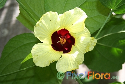
Hibiscus calyphyllus (Lemon Yellow Rosemallow)180 (250)cm, Lemon Yellow Rosemallow is a woody perennial shrub from tropical Africa and has hairy, large leaves and large, pale yellow flowers with a maroon center. For any rich, well drained substrate in a sunny spot throughout the year. In winter keep slightly drier at a minimum of some 15°C. V-IX. |
| price (plus Shipping Costs) | |||
|---|---|---|---|
| seed package9102 | € 2,99 | ||
|
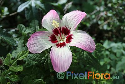
Hibiscus cameronii (Cameron's Hibiscus)100 (150)cm, Cameron's Hibiscus is an evergreen species from Madagascar, and extremely rare in cultivation. Hibiscus cameronii has soft woody branches with lobed leaves and showy, rather large light pink and white flowers with an inner wine red halo. In literature there is some confusion on this species as it is mentioned to be a parent of modern day Hibiscus x rosa-sinensis hybrids. Hibiscus cameronii belongs to section Furcaria whereas all Hibiscus x rosa-sinensis to section Lilibiscus, and these two sections do not hybridize at all with each other. The name "cameronii" (sometimes also spelled "cameroni") was misapplied to some early Hibisus liliflorus hybrid and does not refer to the true Hibiscus cameronii. For any rich, well drained substrate in full sun throughout the year and careful watering in winter at a minimum of 20°C. Germination in this species occurs unevenly over several weeks to months. Seeds are extremely scarce and you may not be able to locate them anywhere else but from us. III-IX. |
| price (plus Shipping Costs) | |||
|---|---|---|---|
| seed package0536 | € 9,90 | ||

|
Hibiscus cf. genevii (Rose Mauritius Mandrinette Hibiscus)150 (200)cm, Rose Mauritius Mandrinette Hibiscus is a rare and highly endangered, evergreen wild species from the island of Mauritius, where is was thought to be extinct until a couple of plants were rediscovered in 1968. The pure species has small leaves and rather large, very ornamental, pale rose flowers. In cultivation there is one genetic line present (our seeds) which most likely is of hybrid origin with probably Hibiscus boryanus as the second elder. Juvenile leaves in these plants are needle like and correspond to the species, however flowers have a somewhat different color with a more orange to salmon tinge. Hence we offer these seeds as Hibiscus cf. genevii, as the identity of these plants is still unclear. Easily grown in any rich, well drained substrate in full sun throughout the year and reduced watering in winter at a minimum of 20°C. Seeds from all Hibiscus species in section Lilibiscus (e.g Hibiscus arnottianus, Hibiscus cooperi, Hibiscus denisonii, Hibiscus fragilis, Hibiscus genevii, etc. ) germinate unevenly over a period of several months. Keep pots in a warm spot and the soil slightlly moist until germination will occur. IV-VII. |
| price (plus Shipping Costs) | |||
|---|---|---|---|
| seed package0686 | € 17,90 |

|
|

|
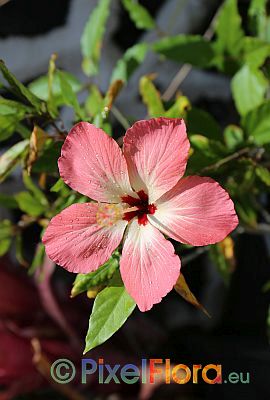
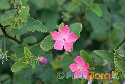
Hibiscus cooperi 'Nasilai Pink'100 (250)cm, Hibiscus cooperi has been reinstated as a species of its own in 2019 and is endemic to Vanuatu in the southern Pacific Ocean. Nowadays it is very rare in habitat, however, it is still being grown in gardens in the Melanesia region. Hibiscus cooperi is one of the two parents of the original Hibiscus x rosa-sinensis, the other parent being Hibiscus kaute, which is endemic to the Marquesa islands, French Polynesia. Hibiscus cooperi is a low woody evergreen shrub with utmost showy, rose pink flowers with an inner red eye and a distinct white halo in the offered form 'Nasilai Pink'. This form can be traced back to cultivated plants found near the village of Nasilai (erroneously also spelled "Naselai"), Nakelo, Fiji island in 1965. In the garden trade Hibiscus cooperi is usually mistaken for Hibiscus storckii which is a different species and which is not present in cultivation. Additional, there is a Hibiscus x rosa-sinensis cultivar, namely 'Cooperi', which is often confused with the species. Even the Royal Botanical Garden at Kew cultivates wrongly identified Hibiscus cooperi in a white and rose form, and labeled as Hibiscus storckii. So if even Kew Gardens doesn't get it right with a proper identification ... Anyway, we do offer true to type seeds from Hibiscus cooperi 'Nasilai Pink'. However, please keep in mind that 'Nasilai Pink' is a particular color selection from Hibiscus cooperi and that this selection is not stable. This means that flowers from seed raised plants will not be identical to this selection. They will usually be very close, but with some variation in flower colors. Seeds from all Hibiscus species in section Lilibiscus (e.g Hibiscus arnottianus, Hibiscus cooperi, Hibiscus x denisonii, Hibiscus fragilis, Hibiscus genevii, Hibiskus kokio, Hibiscus mabberleyi, etc. ) germinate unevenly over a period of several months. Keep pots in a warm spot and the soil slightlly moist until germination will occur. For any rich, well drained substrate in full sun throughout the year and reduced watering in winter at a minimum of some 20°C. V-IX. |
| price (plus Shipping Costs) | ||||
|---|---|---|---|---|
| seed package0346 | € 7,90 | |||
|
||||
|
Hibiscus ferrugineus100 (150)cm, a rarely cultivated evergreen species from Madagascar which has slightly woody stems and small leaves and showy pale coral pink flowers. For any rich, well drained substrate in full sun throughout the year and reduced watering in winter at a minimum of 20°C. III-IX. |
| price (plus Shipping Costs) | |||
|---|---|---|---|
| seed package0249 | € 7,99 | ||

|
Hibiscus fragilis (Orange Mauritius Mandrinette Hibiscus)70 (120)cm, Orange Mauritius Mandrinette Hibiscus is an orange flowering form which is known from a single population only in western Mauritius. Apart from the flower color it differs in several aspects from the nominal red form, having a more erect habit and bearing small leathery, more densely pubescent, mid green leaves. It will probably be separated as a subspecies in the closer future. Easily grown in any rich, well drained substrate in full sun throughout the year and reduced watering in winter at a minimum of 20°C. Seeds from all Hibiscus species in section Lilibiscus (e.g Hibiscus arnottianus, Hibiscus cooperi, Hibiscus fragilis, Hibiscus genevii, Hibiscus mabberleyi, Hibiscus waimeae, etc.) germinate unevenly over a period of several months. Keep pots in a warm spot and the soil slightly moist until germination will occur. A first time offer, and seeds are worldwide exlusively available from us. III-X. |
| price (plus Shipping Costs) | |||
|---|---|---|---|
| seed package0762 | € 39,90 |
|
|

|
Hibiscus fragilis (Pink Mauritius Mandrinette Hibiscus)50 (90)cm, Pink Mauritius Mandrinette Hibiscus is an extremly rare and highly endangered, evergreen wild species from the island of Mauritius. It has a slightly prostrate habit and bears small leathery dark green leaves and ornamental, and for size of the plant rather large, rich pink (orange in an extremely are form) flowers. Easily grown in any rich, well drained substrate in full sun throughout the year and reduced watering in winter at a minimum of 20°C. Seeds from all Hibiscus species in section Lilibiscus (e.g Hibiscus arnottianus, Hibiscus cooperi, Hibiscus fragilis, Hibiscus genevii, Hibiscus mabberleyi, etc.) germinate unevenly over a period of several months. Keep pots in a warm spot and the soil slightly moist until germination will occur. Between around 2017 and 2022 a wholesale company had been distributing wrongly identified seeds from probably a hybrid under the name of Hibiscus fragilis, and several resellers resold these false seeds worldwide. Our seeds are from true, unhybridized, true-to-type plants being cultivated by ourselves, and the photo shows a flower from one of our mother plants. From us you will get the real deal. III-VII. |
| price (plus Shipping Costs) | |||
|---|---|---|---|
| seed package0248 | € 14,90 | ||
|
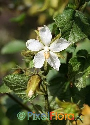
Hibiscus fuscus150 (200)cm, a woody perennial shrub with hairy, ovate to sub-orbicular leaves and numerous small pure white flowers. Native of mountainous open sites in woods and grasslands from Ethiopia to South Africa. For any rich, well drained substrate in a sunny spot throughout the year. In winter keep drier at a minimum of some 10°C. VII-IX. |
| price (plus Shipping Costs) | |||
|---|---|---|---|
| seed package 4960 | € 2,99 | ||

|
Hibiscus igneus (Orange Mandrinette Hibiscus)180 (300)cm, Orange Mandrinette Hibiscus is a rare and endangered, usually evergreen wild species from the Mascarene island of La Réunion. Hibiscus igneus was formerly regarded a reddish orange color form of Hibiscus boryanus. Yet due to recent studies published in June 2025, it was separated from the latter and described as a new species, namely Hibiscus igneus. It has glossy dark green leaves and ornamental, bright orange-red flowers with a yellow center. Easily grown in any rich, well drained substrate in full sun throughout the year and reduced watering in winter at a minimum of 20°C. Seeds from all Hibiscus species in section Lilibiscus (e.g Hibiscus arnottianus, Hibiscus cooperi, Hibiscus denisonii, Hibiscus fragilis, Hibiscus genevii, etc. ) germinate unevenly over a period of several months. Keep pots in a warm spot and the soil slightlly moist until germination will occur. Offered seeds are from our own true-to-type and hand pollinated plants. Available are seeds from two distinct clones. Clone 1 is the one which has been offered by us in the past, wheres clone 2 is a more recently added second genetic line. However, morphologically both clones are more or less identical. VI-X. |
| price (plus Shipping Costs) | ||||
|---|---|---|---|---|
| seed package (clone 1)9080 | € 14,90 | |||
|
||||
| seed package (clone 2)0669 | € 19,90 | |||
|
||||

|
Hibiscus insularis (Phillip Island Hibiscus)120 (200)cm, Phillip Island Hibiscus is one of the most endangered plant species in the world. Hibiscus insularis was down to just two genetically distinct specimens in habitat on Phillip Island, south of Norfolk Island, 1.400 km offshore eastern Australia. It is a medium tall evergreen shrub with leathery, shiny dark green leaves with crenulate margins and very showy, greenish-yellow flowers turning to dark rose at maturity, and with an reddish violet eye. On adult specimens flowers are set in abundance, yet seed set is extremely erratic despite careful hand pollination. Most plants in cultivation are from cuttings from the last two wild specimens, thus the genetic variation is extremely low in this species, and which may be the cause of a very low seed set. Also, germination in this species in unpredictable and it will take several months to almost an entire year. As a matter of fact, it is probably the most complicated species we have to get going from seeds. Our seeds were collected in March 2024 and are as fresh as they can be. Each single seed is visually inspected and all potentially unviable seeds are discarded. Germination tests yielded a germination rate between 15% to 25% under optimal conditions. However, we cannot give any guarantee on germination. In the best case you may be able to raise some 1 to 2 seedlings from one seed package, in the worst case there will be no germination at all. So be prepared not to have any success! Sowing is the very same as for other tropical Hibiscus species. Prior to sowing preferably soak seeds for 48 h in luke warm water. Use any rich, well drained substrate and keep pots at around 25°C in a partially shaded spot. In their first years seedlings will look very differently from adult plants. Leaves in immature plants will be very small and strongly lobed, upon maturity leaves will develop their adult and more round shape. For any rich, well drained substrate in a partially shaded (summer) to sunny (winter) spot at a minimum of some 20°C. V-X. |
| price (plus Shipping Costs) | |||
|---|---|---|---|
| seed package0662 | € 29,90 | ||

|
Hibiscus mabberleyi (Mabberley's Hibiscus)180 (240)cm, Mabberley's Hibiscus is an in 2023 new described species which is extinct in nature, where it was supposedly native to some Mascarene islands. Few specimens are still grown by botanical gardens and a handful of private cultivators, where this species had been labelled Hibiscus denisonii until recently. Hibiscus mabberleyi has finely pubescent leaves. There are at least two genetic lines still alive in cultivation, one with white flowers upon opening, later fading to very pale rose (photo), and a second and much rarer one with flowers which will stay white. The rose flowering form is sometimes confused with Hibiscus x denisonii or Hibiscus storckii, which both are different taxa. All plants sold as Hibiscus storckii are in fact Hibiscus cooperi. Easily grown in any rich, well drained substrate in full sun throughout the year and reduced watering in winter at a minimum of 20°C. True to type seeds are worldwide exclusively available from Rareplants.eu . Seeds from all Hibiscus species in section Lilibiscus (e.g Hibiscus arnottianus, Hibiscus cooperi, Hibiscus x denisonii, Hibiscus fragilis, Hibiscus genevii, Hibiscus mabberleyi, etc.) germinate unevenly over a period of several months. Keep pots in a warm spot and the soil slightlly moist until germination will occur. Seeds are extremely scarce and they are supplied on a first-come-first-served basis. The tested germination rate is > 80% in this species under optimal conditions. VI-X. |
| price (plus Shipping Costs) | ||||
|---|---|---|---|---|
| seed package0609 | € 29,90 | |||
|
||||
|
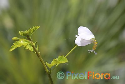
Hibiscus meyeri (Meyer's Hibiscus)100 (170)cm, Meyer's Hibiscus is a small woody, slender shrub with hairy, small serrated ovate leaves and small white flowers with reflexing petals, turning pale whitish pink with age. Hibiscus meyeri is native of open sites in mountain forests
from Mozambique to eastern South Africa. It is sometimes confused with somewhat similar Hibiscus micranthus, which has even smaller flowers. For any rich, well drained substrate in a sunny spot throughout the year. In winter keep drier at a minimum of some 15°C. VI-IX. |
| price (plus Shipping Costs) | |||
|---|---|---|---|
| seed package4961 | € 7,99 | ||

|
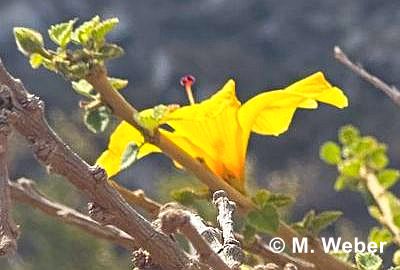
Hibiscus noli-tangere (Do-Not-Touch-Me Hibiscus)120 (200)cm, Do-Not-Touch-Me Hibiscus is an endangered, evergreen woody shrub from Socotra island, offshore Yemen, where it occurs in open spots in dry mountain forests. It has small leaves and surprisingly large, rich yellow flowers with a small dark red center. As in most Socotran endemic hibiscus species the entire plant is covered with short irritating hairs (hence its latin name, which we also used to apply a common name). Always handle plants with care and gloves, and always with wind coming from your backside. For any rich, well drained substrate in full sun throughout the year and reduced watering in winter at a minimum of some 20°C. Hibiscus noli-tangere is one out of nine look-alike yellow flowering species which are all endemic to Socotra, and which are easily confused: Hibiscus dioscorides, Hibiscus diriffan, Hibiscus macropodus, Hibiscus malacophyllus, Hibiscus noli-tangere, Hibiscus quattenensis, Hibiscus scottii, Hibiscus socotranus and Hibiscus stenanthus. Live plants from Hibiscus noli-tangere are located in two collections only and this is a worldwide first time offer for seeds from this unique species. Seeds are extremely scarce and once sold it may take several years before we can offer them again - similar to Hibiscus scottii which we could offer so far only once in the past and since then our plants have not set any seeds again. V-IX. |
| price (plus Shipping Costs) | ||||
|---|---|---|---|---|
| seed package0948 | € 49,90 | |||
|
||||
|
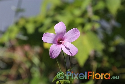
Hibiscus pedunculatus (Dainty Hibiscus)30 (80)cm, Dainty Hibiscus is a semi perennial Hibiscus species from coastal forests in the Cape Province of South Africa. It is a fast growing ornamental plant with prostate to upright hold stems with for the size of the plant rather large, bright pink flowers on very long peduncles. Hibiscus pedunculatus is morphologically undistinguishable from Hibiscus geranioides which is a supposedly native of northern Australia. However, Hibiscus geranioides is an unresolved name, and it most likely represents Hibiscus pedunculatus which may have escaped from cultivation in Australia and became naturalized. For any rich, well drained substrate in a sunny spot. In winter reduce watering and keep plants at a minimum of some 20°C. Our seeds are from correctly identified, true to type, pink flowering Hibiscus pedunculatus. VII-IX. |
| price (plus Shipping Costs) | |||
|---|---|---|---|
| seed package2397 | € 4,99 | ||

|
Hibiscus praeteritus100 (150)cm, a rarely cultivated fast growing evergreen sub shrub fromopen sunny spots in South Africa and adjacent countries. Hibiscus praeteritus has serrated leaves and bright salmon red to more rarely pink flowers. For any rich, well drained substrate in full sun throughout the year and reduced watering in winter at a minimum of 20°C. III-IX. |
| price (plus Shipping Costs) | |||
|---|---|---|---|
| seed package0670 | € 7,99 | ||
|
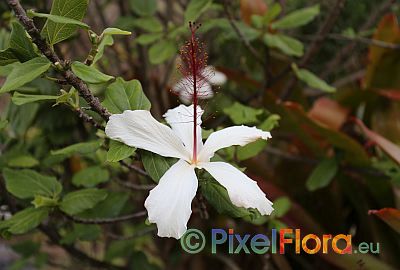
Hibiscus punaluuensis (Fragrant White Aloalo Hibiscus)250 (500)cm, Fragrant White Aloalo Hibiscus (syn. Hibiscus arnottianus ssp. punaluuensis) is an endangered, tall evergreen woody shrub native of the Ko'olau Range on O'ahu, Hawaii, USA. It is one out of few slightly fragrant Hibiscus species which are all endemic to the Hawaiian archipielago. Hibiscus punaluuensis has dark green, large oval leaves and showy slightly fragrant pure white flowers with a long protruding reddish pistil. Whereas most hibiscus species in section Lilibiscus can be easily propagated by semi woody stem cuttings, for us this has proven extremely difficult in Hibiscus punaluuensis, as only one out of several dozens cuttings may eventually root. So the easier way for propagation is via seeds. Our seeds are from pure, unhybridized, true-to-type plants. For any rich, well drained substrate in a partially shaded (summer) to sunny (winter) spot at a minimum of some 15°C. VI-X. |
| price (plus Shipping Costs) | ||||
|---|---|---|---|---|
| seed package0597 | € 39,90 |
|
||
|
||||
|
Hibiscus scottii (Scott's Hibiscus)120 (200)cm, Scott's Hibiscus is an utmost desirable, extremely rare and endangered, evergreen small woody shrub from Socotra island, offshore Yemen, where it occurs in open spots in dry forests. It has small glossy dark green leaves and surprisingly large, rich yellow flowers with a small dark red center. For any rich, well drained substrate in full sun throughout the year and reduced watering in winter at a minimum of some 20°C. Hibiscus scottii is one out of nine look-alike yellow flowering species which are endemic to Socotra, and which are easily confused: Hibiscus dioscorides, Hibiscus diriffan, Hibiscus macropodus, Hibiscus malacophyllus, Hibiscus noli-tangere, Hibiscus quattenensis, Hibiscus scottii, Hibiscus socotranus and Hibiscus stenanthus. Socotra hosts even more yellow flowering endemic Hibiscus species (plus several probably introduced African species), yet these are more easily recognizable. Most (if not all) specimens which are labelled Hibiscus diriffan in cultivation are actually Hibiscus scottii. The problem has emerged as the original collection of Hibiscus scottii had been wrongly identified as Hibiscus diriffan, and probably all existing plants in cultivation descend from this single collection. Leaves in Hibiscus scottii are highly variable, they may have an obtuse, orbicular, or elliptical shape, the leaf margins are either entire, serrated or crenulate and the leaf base may be cordate, rounded, or truncate. Even a particular plant may change its leaf shape from a juvenile to an adult stage, and later in its adult stage again depending on cultivation conditions. Thus the leaf shape does not serve to identify plants. The only true distinctive and unique trait in Hibiscus scottii are very short rusty-brown hairs on the calyx and epicalyx, as well as the lower base outside the petals. Our plants are correctly identified and true-to-type. V-IX. |
| price (plus Shipping Costs) | |||
|---|---|---|---|
| seed package0340 | € 39,90 |
|
|
|
|
Hibiscus sturtii var. platychlamys (Australian Hill Hibiscus)40 (120)cm, Australian Hill Hibiscus is a rarely cultivated small Hibiscus species with a somewhat prostate habit and pale rose flowers above showy whitish to silvery-green, finely pubescent leaves. The variety Hibiscus sturtii var. platychlamys is native of dryish soil in dry shrub formations in Western Australia, northern Central Australia and North Australia. For any rich, very well drained substrate in full sun throughout the year and watering reduced to a minimum in winter at a minimum of 20°C. V-VIII. |
| price (plus Shipping Costs) | |||
|---|---|---|---|
| seed package0681 | € 7,99 | ||
|
Hibiscus trionum (Flower-of-an-hour Hibiscus)30 (50)cm, Flower-of-an-hour Hibiscus is a fast growing, strictly annual tropical Hibiscus from central Africa. It produces ornamental, pale yellow flowers with a dark violet-black center in terminal umbels. After flowering and setting seeds plants will inevitably die down. However, even in colder climates Hibiscus trionum will readily self-sow under suitable conditions as seeds are frost resistent. For any well drained soil in full sun. An excellent plant for the rock garden. On the web sometimes Hibiscus 'Amethyst' is offered as an alleged cultivar of Hibiscus trionum. However, it is indistinguishable from the variable nominal form. Additionally, some apparently plant unexperienced vendors offer seeds from Hibiscus trionum under the name of Hibiscus cannabinus 'Amethyst', which itself is a trademarked name for a cultivar of a completely different species. Hibiscus trionum makes terminal, smoothly hairy seed capsules, whereas Hibiscus cannabinus has axillary, quite hard capsules covered with short and bristle hairs. Our seeds are from correctly identified, true to type plants and offered at an all-time low price. VI-IX. |
| price (plus Shipping Costs) | |||
|---|---|---|---|
| seed package 2027 | € 0,99 | ||

|
Hibiscus waimeae (Fragrant White Waimea Valley Hibiscus)200 (450)cm, Fragrant White Waimea Valley Hibiscus (or locally also called "Koki'o ke'o ke'o") is a critically endangered, tall evergreen woody shrub endemic of the Waimea and adjacent valleys in the western and southwestern parts of the island of Kauaʻi, Hawaii, USA. It is one out of few slightly fragrant Hibiscus species which are all endemic to the Hawaiian archipielago. Hibiscus waimeae is very similar to Hibiscus punaluuensis and differs in an overall more compact growth habit, somewhat smaller rounded to broadly ovate leaves and slightly smaller white flowers with significantly broader petals and a shorter, intense reddish pistil. Our seeds are from pure, unhybridized, true-to-type plants. For any rich, well drained substrate in a partially shaded (summer) to sunny (winter) spot at a minimum of some 15°C. VI-X. |
| price (plus Shipping Costs) | |||
|---|---|---|---|
| seed package0664 | € 39,90 |
|
|

|
Hibiscus x denisonii (Denison's Hibiscus)120 (160)cm, Denison's Hibiscus used to be a mysterious plant until 2023. Since a new revision and publication it is now regarded to be a very old stabilized polyploid and fully fertile hybrid, involving probably three species, namely Hibiscus boryanus, Hibiscus fragilis and Hibiscus mabberleyi. The latter was formerly included in the now superseded taxon Hibiscus denisonii, yet in 2023 it was separated and described as a new species of its own. While some other plants, formerly also included in Hibiscus denisonii, had been recognized to be of hybrid origin and thus these were renamed to present Hibiscus x denisonii (note the "x" in the new name!). Hibiscus x denisonii is sometimes confused with Hibiscus storckii, which is a different species and which at present does not seem to be in cultivation. All plants being sold as Hibiscus storckii are in fact Hibiscus cooperi. Hibiscus x denisonii is an evergreen plant with glossy dark green, leathery leaves and ornamental, pale rose flowers with some bluish shade, especially on the second day. If grown under glass petals tend to stay paler to almost white. It appears very likely that from Hibiscus x denisonii (or at least involving an offspring named 'Hale Blue') the very first bluish, maroon and greenish flowering, modern tropical hibiscus hybrids were created in the 50ties of last century. Unfortunately 'Hale Blue' hasn't been seen again for the past 30 years and is probably not in cultivation anymore. Hibiscus x denisonii almost shared the same fate with little more than a handful of specimens left at some point. Yet it could be saved in the very last minute and is now available again to the broader public. This will give new opportunities to create some more modern lines of bluish, greyish, maroon or greenish flowering tropical hibiscus hybrids. Hibiscus x denisonii is a stabilized hybrid which comes true from seeds. This means that seed grown plants will be almost identical to the mother plant with very little variation. It is easily grown in any rich, well drained substrate in full sun throughout the year and reduced watering in winter at a minimum of 20°C. Seeds from all Hibiscus species in section Lilibiscus (e.g Hibiscus arnottianus, Hibiscus clayi, Hibiscus cooperi, Hibiscus x denisonii, Hibiscus fragilis, Hibiscus genevii, etc.) germinate unevenly over a period of several months. Keep pots in a warm spot and the soil slightlly moist until germination will occur. Only 3 packages are still available. VI-X. |
| price (plus Shipping Costs) | |||
|---|---|---|---|
| seed package0287 | € 19,90 |
|
|
|
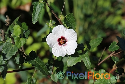
Pavonia hastata (Spearleaf Swampmallow)100 (140)cm, Spearleaf Swampmallow is an ornamental perennial from South America (Brazil, Bolivia, Argentina, Paraguay, and Uruguay). It makes slender, somewhat prostate stems with narrow leaves and numerous light rose flowers in summer. Similar to several other Pavonia species, Pavonia hastata produces cleistogamous flowers in summer with long days and short nights, i.e. flowers produce seed without opening. With shorter days in autumn and spring, flowers open completely. Pavonia hastata is sometimes offered as Pavonia brasiliensis, which is an unresolved name. For any rich, well drained substrate in a sunny spot throughout the year. In winter keep drier at a minimum of some 15°C. V-VIII. |
| price (plus Shipping Costs) | |||
|---|---|---|---|
| seed package0252 | € 2,99 | ||

|
Pavonia missionum (Red Pavonia)40 (70)cm, Red Pavonia is an ornamental small perennial from South America (southern Brazil, Argentina, and Paraguay). It has broad lanceolate, slightly lobed leaves and showy, bright orange-red flowers. It is usually mistaken for the very similar Pavonia rubra which is not in cultivation. For any rich, well drained substrate in a sunny spot throughout the year. In winter keep drier at a minimum of some 15°C. V-VIII. |
| price (plus Shipping Costs) | |||
|---|---|---|---|
| seed package0329 | € 4,99 | ||
|
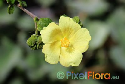
Pavonia praemorsa (Yellow Mallow)50 (10)cm, Yellow Mallow is a perennial dwarf shrub from South Africa with woody stems, glossy green leaves and showy pale lemon-yellow flowers throughout the year. For any rich, well drained substrate in a sunny spot throughout the year. In winter water plants carefully and keep them at a minimum of some 15°C. Pavonia praemorsa is an excellent pot plant. I-XII. |
| price (plus Shipping Costs) | |||
|---|---|---|---|
| seed package0557 | € 2,99 | ||


Recently Added


Top Sellers



- bank transfer
- giro pay
- sending cash


