your basket is empty
 View Basket
 Recover Basket

Hibiscus (Hardy Mallow)
|
Hardy Mallows or hardy Hibiscus are mostly growing as perennial, woody shrubs. All require a well drained soil in full sun and plenty of water in summer, so that they make their flowers in profusion all summer long. Sow flat preferably in spring at some 20°C in any rocky or sandy soil, keep pots always sunny. Transplant seedlings as soon as they are strong enough. All are USDA Climate Zone 6/7. 20 seeds per package, unless stated differently. You find more hibiscus in these categories: Muenchhusia (Swamp Mallow) & Kosteletzkya (Saltmarsh Mallow), Hibiscus (Tropical Hibiscus) & Pavonia and Tropical Hibiscus Hybrids. U.S. customers only: Hibiscus seeds cannot be shipped to the U.S. |
Articles
|
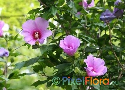
Hibiscus syriacus (Chinese Hibiscus)170 (300)cm, Chinese Hibiscus is a winterhardy woody, deciduous shrub which produces numerous purplish, mauve or, more rarely, white flowers throughout summer. Despite its botanical name it is native of China and not Syria. Hibiscus syriacus is easily grown in any rich soil in a sunny to partially shaded spot. Offered seeds are from plants with mostly rose to lilac flowers, very few seedlings may be white flowering. VI-IX. |
| price (plus Shipping Costs) | |||
|---|---|---|---|
| seed package2888 | € 2,99 | ||
|
|
Muenchhusia grandiflora (Giant Swamp Mallow)200 (300)cm, Giant Swamp Mallow (syn. Hibiscus grandiflorus) is an eye-catching, yet still rarely cultivated perennial herbaceous shrub from wet areas in south-eastern USA (Florida). It makes very tall annual stalks with very large, always pale rose flowers, which is the typical and only color in this species. Additionally, petals are narrower than in any other North American swamp mallow species. Leaves are palmately-divided, greyish-green, and smoothly pubescent. The annual stalks usually die down in winter and the plant re-sprouts in following spring. For any very humus rich, always slightly moist soil in full sun. During winter cover the dormant rootstock with a mulch-layer to give some additional protection from freezing through. Seeds or plants in the garden trade are mostly either Hibiscus moscheutos or some hybrid with an atypical flower color and form. Our seeds are from true-to-type plants. VII-IX. |
| price (plus Shipping Costs) | |||
|---|---|---|---|
| seed package0271 | € 7,99 |

|
|
|
|
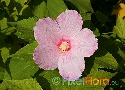
Muenchhusia laevis (Halberdleaf Rosemallow)150 (200)cm, Halberdleaf Rosemallow (syn. Hibiscus militaris, syn. Hibiscus laevis) is similar in appearance to the Swamp Mallow Rose (Hibiscus moscheutos), yet the light pink flowers are more trumpet shaped and show a darker inner blotch. It is native of wetlands and moist woods in North America. For any always slightly moist, humus rich soil in full sun. Plants die back in autumn and go dormant during winter. During winter stop watering and preferably cover the dormant rootstock with a mulch-layer to give some additional protection from freezing through. The rootstock makes new shoots by mid spring. VII-IX. |
| price (plus Shipping Costs) | |||
|---|---|---|---|
| seed package 3621 | € 7,99 | ||
|
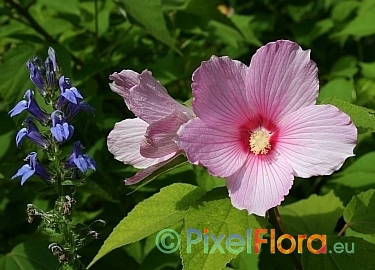
Muenchhusia moscheutos (Swamp Rose Mallow)150 (200)cm, Swamp Rose Mallow (syn. Hibiscus moscheutos) is native from lakeshores, swamps and wetlands in the US. Makes ornamental, large pink to pure white cup shaped flowers. For any always moist, very leafy soil in full sun. Plants die back in autumn and go dormant during winter. The rootstock makes new shoots by mid spring. VII-IX. |
| price (plus Shipping Costs) | ||||
|---|---|---|---|---|
| seed package2886 | € 3,99* | |||
|
||||
|
|
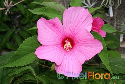
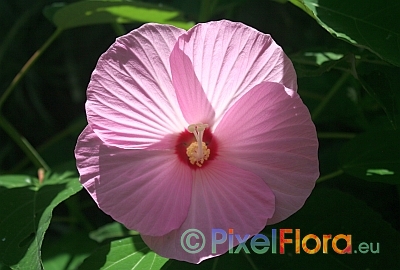
Muenchhusia moscheutos [ssp. palustris] (Swamp Rose-Mallow)170 (220)cm, Swamp Rose-Mallow (syn. Hibiscus palustris, syn. Hibiscus moscheutos ssp. palustris) has been included into Muenchhusia moscheuta in the latest taxonomic revision in 2025. It is a herbaceous perennial with several erect stems covered with light green leaves. In contrast to the nominal form of Muenchhusia moscheutos , this form always has rich pink flower cups - thus we keep it as a separate subspecies. It is endemic to marshes and alongside wetlands in northeastern North America only. Reports from supposedly native wild populations in southwestern Europe and other parts of the world outside the USA all refer to human introductions and garden escapes. None of the species and subspecies within the genus Muenchhusia is native of Europe, but their distributional area is strictly confined to the New World, except for Hibiscus ponticus which is closely related to Muenchhusia moscheutos ssp. moscheutos which is supposedly endemic to Georgia in the Caucasis - though some authors believe that Hibiscus ponticus is rather an old human introduction of Muenchhusia moscheutos ssp. moscheutos . For any humus rich, well drained, always slightly moist soil or at the edge of a pond or stream in a sunny spot. VII-IX. |
| price (plus Shipping Costs) | |||
|---|---|---|---|
| seed package 1018 | € 7,99 | ||
|
Muenchhusia moscheutos ssp. lasiocarpa (Crimsoneyed Rosemallow)180 (250)cm, Crimsoneyed Rosemallow) (syn. Hibiscus lasiocarpus, syn. Hibiscus moscheutos ssp. lasiocarpos) is a herbaceous perennial with several upright stems with white to pale rose, more rarely intense rose flowers with a small dark purplish red center and finely pubescent leaves. Muenchhusia moscheutos ssp. lasiocarpa is native of moist, humus rich spots in wetlands in southern USA. A variety being endemic to California with always white flowers and more silvery-green leaves has been described as Hibiscus lasiocarpus var. occidentalis. For any humus rich, always slightly moist soil in a sunny spot, excellent at the edge of a pond or a water stream. VII-X. |
| price (plus Shipping Costs) | ||||
|---|---|---|---|---|
| seed package 1017 | € 7,99 | |||
|
||||


Recently Added


Top Sellers




- bank transfer
- giro pay
- sending cash


